Strategic partnership
BAC × Africa Web3 Institute
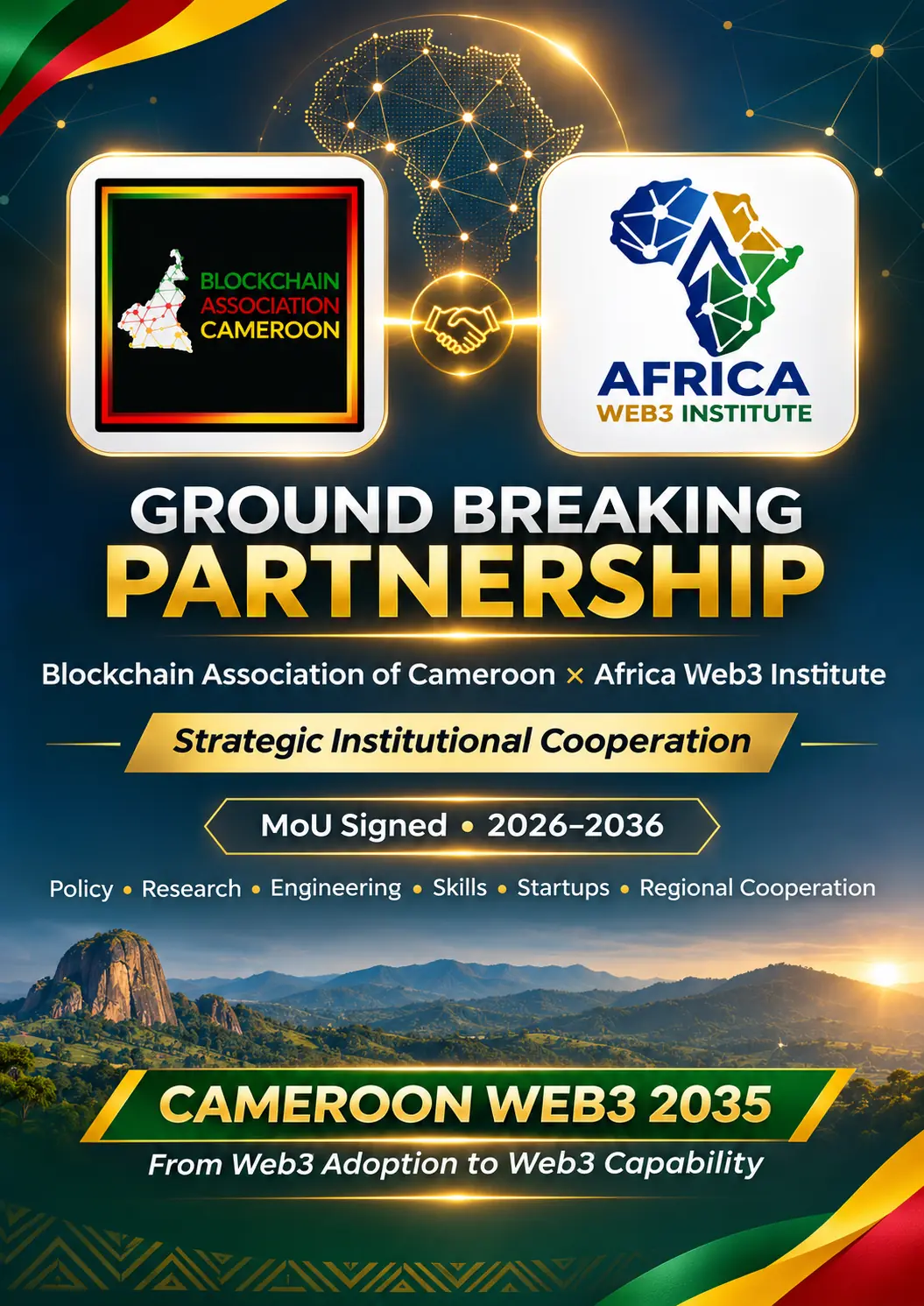
A framework for institutional cooperation over 2026–2036 on policy, research, engineering, skills, startups and regional cooperation, under the umbrella “Cameroon Web3 2035”.
- Instrument
- Memorandum of Understanding
- Signed
- November 2026
- Strategic horizon
- 2026–2036
- Umbrella
- Cameroon Web3 2035
Two complementary organizations
Blockchain Association of Cameroon
A national ecosystem, policy and capacity-building mission in Cameroon, including the BAC Layer-0 Developer Academy and related engineering capability initiatives.
Africa Web3 Institute
A pan-African orientation in policy research, education, regulatory analysis, capacity building and ecosystem development.
Shared vision
Cameroon Web3 2035
From Web3 Adoption to Web3 Capability
The Parties aim to strengthen Cameroon's ability to build, operate, secure, research, govern and responsibly commercialize blockchain and Web3 systems, and to contribute to capability development across Central Africa.
Areas of cooperation
Six areas, one framework
01
Policy
Public-policy, regulatory, legal and institutional capacity building relating to blockchain, Web3 and digital assets. Public-sector programs are education and evidence-based engagement, not lobbying or claims of governmental endorsement.
02
Research
Joint research, policy intelligence, publications and evidence-based observatories or indexes. The Parties may develop a State of Web3 in Cameroon report, regulatory and policy trackers, talent and startup studies, infrastructure assessments and a Cameroon Web3 Index.
03
Engineering
Blockchain and distributed-systems engineering education, with the BAC Layer-0 Developer Academy as BAC's principal technical engineering platform, alongside technical laboratories, test environments, interoperability experiments and cybersecurity capability.
04
Skills
Executive, public-sector, regulator, legal-professional and institutional learning programs, and university cooperation: faculty development, research partnerships, student pathways and laboratory collaboration.
05
Startups
Structured pathways connecting education, research and entrepreneurship: startup discovery, pre-incubation, incubation, commercialization support, investor readiness and ecosystem grants.
06
Regional cooperation
The Parties intend to evaluate Cameroon as a potential jointly coordinated regional hub for validated programs serving CEMAC and CEEAC stakeholders. Regional expansion is to be evidence-led and not to precede adequate national delivery, funding, legal review and quality controls.
How it works
Complementary, not merged
- Each organization keeps its identity, independence and pre-existing assets.
- The BAC Layer-0 Developer Academy remains anchored in BAC, which keeps authority over its curriculum standards, technical examinations and certification rules.
- AWI's pan-African policy, research and ecosystem programs remain anchored in AWI.
- The MoU is an umbrella instrument. Activities, budgets and deliverables are defined in separate numbered Implementation Agreements.
- Research stays independent: sponsors may support it but cannot purchase findings, and funding does not influence research conclusions or certification outcomes.
- The cooperation is non-exclusive: each organization remains free to work with other institutions.
What is intended next
Intentions, not yet achievements
- The Parties intend to develop a joint policy and research platform, provisionally called the Cameroon & Central Africa Web3 Policy and Innovation Center, initially as a jointly governed program. It requires a dedicated Implementation Agreement before it begins material operations.
- Country nodes, regional cohorts, remote laboratories or certification delivery would each require separate written arrangements.
What this framework is not
- It is not a joint venture, an agency or a legal partnership. Except for specific provisions identified as legally binding, it records the Parties' present good-faith intentions.
- It does not create any obligation to fund, invest or enter into a specific transaction. No equity investment, venture fund or venture studio is created under it without separate legal, tax, governance and financial approval.
- No activity under it provides unlicensed financial, investment, custody or exchange services, and it is not an endorsement of any token, investment product or financial return.
This page summarizes the public elements of the Memorandum of Understanding. Detailed activities, budgets and operational commitments are set out in separate Implementation Agreements.
Interested in the partnership?
To discuss collaboration, research, training or startup programs connected to this partnership, contact the BAC General Secretariat.
Contact BAC